Firmware and connected-device software for systems that read
sensors, operate equipment and exchange information.
From an ESP32 controller to a connected monitoring system, we define
what runs on the device, how it communicates and what happens when
something fails.
Device software needs to handle physical inputs, operating rules and
faults—not just display measurements on a screen.
Firmware & Device Control
Software running on a microcontroller that reads conditions,
applies defined rules and controls connected equipment.
Sensor inputs
Read and validate measurements from supported sensors, including
how missing or implausible readings are handled.
Outputs & actuators
Control compatible valves, relays or other outputs within the
operating conditions defined for the device.
Operating rules
Define automatic and manual operation, thresholds, timing,
startup behaviour and responses to interruptions.
Fault handling
Detect specified faults, record relevant events and apply the
agreed response for each condition.
Sensor Monitoring & Alerts
Collect device readings and operating status so a business can see
what is happening without checking equipment individually.
Measurements, device health, event history, thresholds and alerts.
Storage and reporting can be local or connected to a server.
Device Connectivity & Integration
Connect compatible controllers to gateways, applications or
existing business systems.
Wired or wireless communication, data formats, device identity,
authenticated access and handling temporary loss of connection.
Supported interfaces are confirmed per device.
Operator Controls & Diagnostics
Give staff the settings, status information and diagnostic tools
appropriate to the equipment they operate.
Local controls or connected mobile/web interfaces, configuration,
fault messages and operating records. Remote commands require
explicit permissions and safeguards.
Examples & solutions
Explore how a controller makes decisions from sensor readings and
reacts to faults.
This is a browser simulation using fictional readings. No physical
controller or irrigation equipment is connected, and it is not a
certified safety system.
Interactive examples require JavaScript.
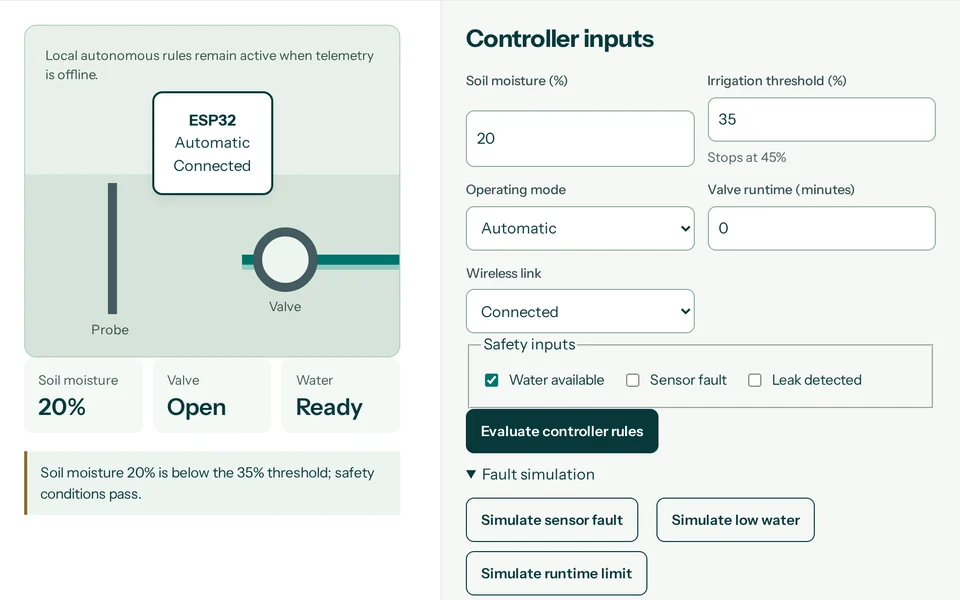
ESP32 irrigation controller
Change soil-moisture readings and irrigation settings, then
evaluate whether the simulated valve opens or stays closed.
Trigger a sensor fault, leak or low-water condition and inspect
the controller decision and event history.
A connected device has to make decisions locally and communicate only
what other systems need. Both parts must be designed for the intended
hardware and environment.
Inputs and outputs
Sensors provide readings; the controller drives supported outputs.
Electrical interfaces, signal ranges and equipment limits are
checked against the actual components.
Local decisions and faults
Firmware applies the agreed rules and defines what the device
should do on startup, after a restart, when a reading is invalid
or when communication fails. Different faults can require
different responses.
Connectivity and access
Where needed, devices send status or readings to a gateway or
server, and authorized users can view or change permitted
settings. Network security and command permissions are part of the
design.
Updates and diagnostics
Logs, configuration, firmware versions and update methods are
established for the project. Remote updates are included only when
the hardware and deployment conditions support them.
A browser simulation can show control rules, but actual firmware must
be tested with the intended hardware, wiring and failure conditions.
Project delivery
From requirements to a working device
Define the device and its limits
We identify the equipment, sensors, outputs, operating
environment, fault conditions and other systems involved. The
proposal defines hardware responsibilities, required functions,
exclusions, milestones and an estimate.
Prove the key behaviour
We establish the device interfaces and important operating rules,
then test the critical inputs and outputs on a suitable prototype
or development setup where hardware work is included.
Develop and test
We implement the agreed firmware and connections. Tests cover
normal operation, invalid readings, restarts, communication loss
and other defined failure conditions, using the intended equipment
where available.
Deliver and hand over
We provide the contracted firmware, source-code rights, build and
configuration instructions, and available test records.
Installation, updates, support and any further hardware work are
agreed separately.
Ownership, maintenance & costs
Can you work with our existing equipment?
We review the controller, sensors, documentation, protocols and
available access before confirming compatibility. Existing
equipment may limit what can be read or controlled.
Do you also build the electronics?
Firmware development and electrical or mechanical design are
different parts of a project. Circuit boards, enclosures, power
supplies, installation, manufacturing and regulatory work are
included only if separately assessed and agreed.
Can the controller operate without internet access?
Yes, if its intended tasks can run locally and it is designed that
way. We define what continues during an outage, what information
is retained and how communication resumes.
How are faults and safety handled?
We define the relevant failure cases and responses for the
equipment, then test them to the agreed scope. Systems with
safety-critical or regulated functions require a separate risk and
compliance assessment; a simulation is not evidence of
certification.
How will firmware be updated?
Updates may require a local connection or an agreed remote
process. The choice depends on hardware support, access, recovery
requirements and who will maintain the devices.
What affects the cost and schedule?
Hardware availability, sensor and device interfaces, control
rules, connectivity, testing and deployment requirements determine
the work. Prototyping, production hardware, certification and
ongoing services are identified separately in the estimate.
What will we own after delivery?
The agreement defines rights to the developed firmware,
third-party licences, source repositories, build instructions,
device configuration and maintenance responsibilities. Production
accounts and any device credentials should be controlled by the
client under an agreed handover plan.
Discuss a project
Tell us what the device needs to measure or control, the equipment
involved and how people should monitor or operate it. If you have a
prototype or hardware documentation, include it. A finished
technical specification is not required.
An agricultural operation needs an ESP32 irrigation controller
that monitors sensors, controls valves, communicates
wirelessly and responds safely to sensor or equipment faults.
Solution
Develop embedded firmware and monitoring tools that evaluate
sensor conditions, command equipment, record status and apply
explicit fault-handling rules.